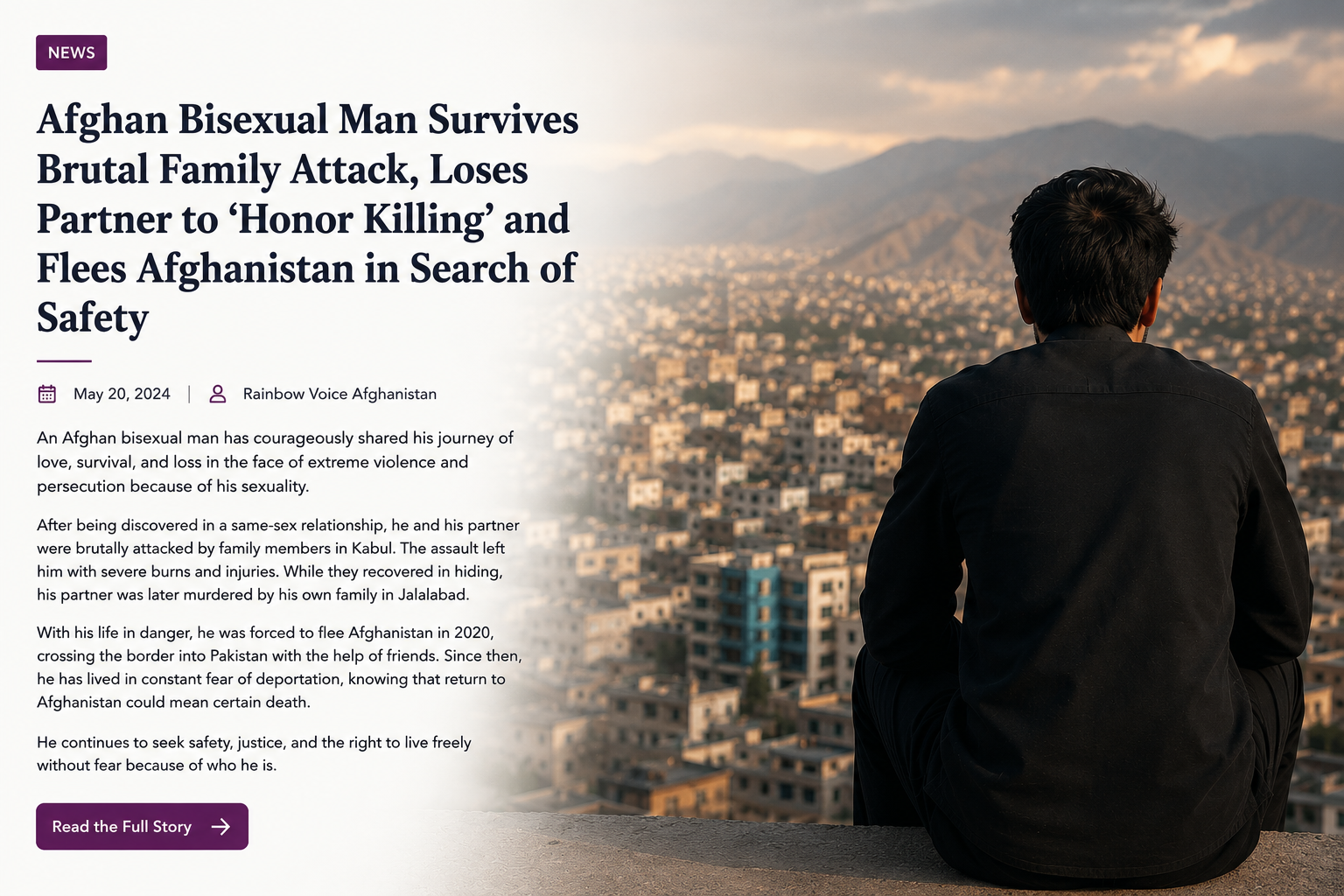
I am an Afghan bisexual man, and I have suffered because of my sexuality for many years. From the time I first understood myself, I knew that my life was different from the lives of many others around me. In Afghanistan, being bisexual meant living in fear because society, families and authorities did not accept LGBTQ+ people.
Meeting Mujeeb
In 2017, I met a boy named Mujeeb at Kabul Zoo Park. I had recently graduated from high school, while he was still in the twelfth grade. We became close friends, and with time we realized that we loved each other.
Mujeeb was originally from Jalalabad, but he lived alone in Kabul so he could finish school. His family remained in Jalalabad. Because a same-sex relationship was considered shameful and dangerous, we kept our relationship completely secret. Neither his family nor mine knew about us. We were always afraid that discovery could put our lives in danger.
I often visited his house because he lived alone and it gave us a rare chance to spend time together safely. We loved each other deeply and dreamed of a peaceful future, but such a life felt impossible in Afghanistan.
Secret community work
In 2018, we joined a small LGBTQ+ group in Kabul. Meeting other LGBTQ+ people was difficult and dangerous. Much of our work happened secretly online using false names. We tried to support LGBTQ+ rights and help others in the community, but we lived with the constant fear of being discovered, attacked or killed.
After Mujeeb finished school, he returned to Jalalabad. The separation was painful, but we continued our relationship. Every few weeks, one of us would travel so we could see each other.
The attack
On September 25, 2019, Mujeeb came to visit me in Kabul. That night, while we were together in my room, my brother suddenly entered. He looked at us, said nothing and left. At first, we hoped he had not understood what he had seen.
The next morning, Mujeeb and I went for an early walk near Karte Naw Park. My brother and three other men followed us. They attacked us and beat us severely. When I asked my brother why he was doing this, he called me a shame to the family. One of the men had a gun, and we stopped resisting because we believed they might kill us.
During the assault, my brother and another man burned both of my legs near my private parts. I lost consciousness and later woke up in a hospital.
No protection or justice
The police arrested three of the attackers, but my brother escaped after taking our phones. During the investigation, members of my family admitted that the attack happened because they believed our relationship had brought shame on the family.
The authorities did not provide meaningful protection or justice. The attackers were eventually released. Police officers closely watched us in the hospital and did not allow visitors. When our condition improved, they took us to a police station. We explained that our families wanted to kill us, but an officer said that the law could not help us. We were released at night with nowhere safe to go.
Losing Mujeeb
We contacted Asad, a gay member of our community. He hid us in his home, cared for us and bought us new phones. He protected us for several months.
Mujeeb became increasingly worried about his mother, who had diabetes and was seriously ill. His sister warned him not to return because the family might kill him. We begged him to stay away, but he felt he had to see his mother once more.
After he returned, his phone suddenly went off. On October 20, 2019, Mujeeb was killed by his family. That was the day I lost the person I loved most. I lost my happiness, my future and my hope.
Escaping Afghanistan
After Mujeeb was killed, I knew that my own family could also kill me. Asad helped me move to another hiding place, but my family continued searching for me and offered money to people who could find me.
On October 29, 2020, Asad told me that I could no longer remain safely in Afghanistan. At the end of October, he arranged for someone to help me cross the Torkham border into Pakistan. He paid 10,000 Afghanis to smugglers who helped me escape.
Life in Pakistan
For a short time after entering Pakistan, I felt safe. Life soon became very difficult. I had no legal documents, no stable home and very little money. I moved between friends’ homes and lived with the daily fear of arrest or deportation.
I went to a United Nations office hoping to receive refugee documentation, but I was told that new cards were not being issued. I fell into deep depression and anxiety. I received medication, but the cause of my trauma could not be removed because the danger continued.
After the Taliban took control of Afghanistan in 2021, my fear became even greater. I believe that deportation would place me at immediate risk from both the Taliban and my family.
My plea for safety
In 2024, I contacted Rainbow Railroad because I no longer knew where else to turn. I am a human being, and I deserve the right to live safely and freely. I have already lost the person I loved, my home, my future and my peace. I do not want to lose my life too.
I only want the chance to live as myself, without the fear of being killed for who I am.
I respectfully ask for help before all my hope disappears. Please help me find safety and a chance to live without fear because of my sexuality.